Which of the Following Are Methods Used to Identify Bacteria
PCR including Real-Time PCR is probably the most widely used molecular technique for identifying microbes. Morphology and Staining 2.
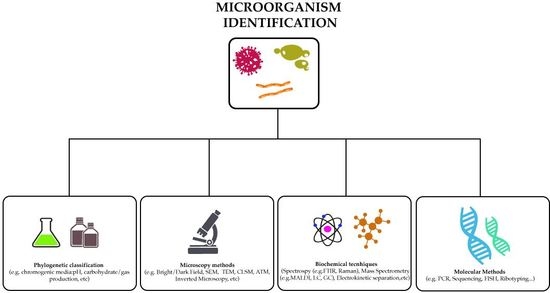
Microorganisms Free Full Text Advances In Chemical And Biological Methods To Identify Microorganisms From Past To Present Html
Identifying Microbes Using PCR.
. Which of the following are methods used to identify bacteria. The appearance of colonies c. 0 of 1 8.
Gram-negative-- Refers to the property of many bacteria that causes them to not take up color with Grams stain a method which is used to identify bacteria. To test whether bacteria contain a catalase enzyme a microbiologist drops hydrogen peroxide into a smear of bacteria on a microscope slide. Common noun bacteria singular bacterium are ubiquitous mostly free-living organisms often consisting of one biological cellThey constitute a large domain of prokaryotic microorganismsTypically a few micrometres in length bacteria were among the first life forms to appear on Earth and are present in most of its habitats.
Animal Pathogen City 7. Which of the following methods is NOT used to identify bacteria. Many of these methods detect bacteria by measuring oxygen.
When identifying bacteria in the laboratory the following characteristics are used. The rate of reproduction. Mycobacteria can also be visualized using the fluorescent dye auramine and a fluorescence microscope.
The shape of the cells Score. The following is an overview of these methodologies. Another microscopic technique is dark ground microscopy.
Which of the following methods is used to help identify prokaryotes by examining how bacteria respond to different nutrients in the media. Legionella Pneumocystis using specific antibodies conjugated to a fluorescent dye. Immunity ie antibacterial response Type of plate nutrient.
Some biochemical tests for microbial identification are quite simple. Fortunately many modern methods for identifying microbes arent dependent on live cultures and they can often reveal minute differences between organisms that escape detection by traditional means. Some of the methods used to identify bacteria are.
Different dyes will react differently to bacteria depending on their unique cellular components. Whether bacteria have an outer membrane or not b. This cannot be done but the total DNA of one organism can be compared with that of any other organism by a method called nucleic acid hybridization or DNA hybridization.
A dye of a different color has to be used in differential stains. Radiocarbon dating using radioactive isotopes Counting rings to count years Crossdating by comparing rings between different trees Identifying the type of fossilized bacteria found in the rings This problem has been solved. Direct immunofluorescence is employed to detect certain pathogens eg.
If the bacteria contain catalase the mixture bubbles as the hydrogen peroxide decomposes into water and oxygen. Gram positive pathogenic bacteria are staphylococci. There is a stain on the fabric caused by grams.
Gram staining shape presence of a capsule bonding tendency motility respiration growth medium and whether it is intra- or extracellular. Most differential stains are used in microbiological treatments in their simplest forms. Bacteria under the Microscope E.
Various staining techniques are as follow 1. To identify bacteria you can perform IMVIC test MRVP test Sugar fermentation testCitrate utilization testNitrate reduction testOxidase and Catalaseand Coagulase tests are the some of. Three major types used for this purpose include chemical assays radio isotopic methods and the use of micro electrodes.
Bacteria b æ k ˈ t ɪər i ə. The ideal means of identifying and classifying bacteria would be to compare each gene sequence in a given strain with the gene sequences for every known species. Multiple Choice A sensity testing Serological testing 0 Microscopic examination of morphology 0 Protein profile analysis 0.
Which of the following are methods used to identify bacteria. Differentiates bacteria into two types Gram positive and Gram negative bacteria Gram positive bacteria can be either cocci or bacilli or vibrios. Form of reproduction 4.
The following points highlight the seven steps for identification of bacteria isolated from a specimen. Some of these include polymerase chain reaction PCR infrared devices that detect bacteria in food and rapid scans that detect bacterial contamination in blood platelets. The isolated bacteria are stained by various methods depending upon the bacteria in focus.
These assays are often utilized to aid in bacterial identification. There are newer more rapid methods of bacterial detection being developed to streamline the process and increase rates of detection.
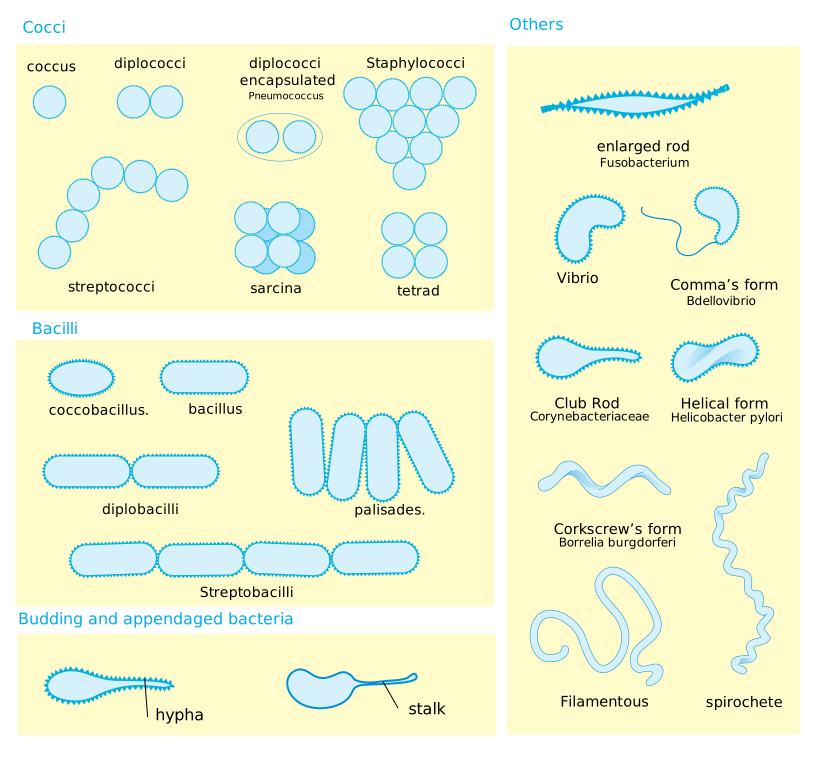
Methods Of Classifying And Identifying Microorganisms Boundless Microbiology

Methods Of Classifying And Identifying Microorganisms Boundless Microbiology

How To Identify Bacteria Bacteria Identify Microbiology
No comments for "Which of the Following Are Methods Used to Identify Bacteria"
Post a Comment